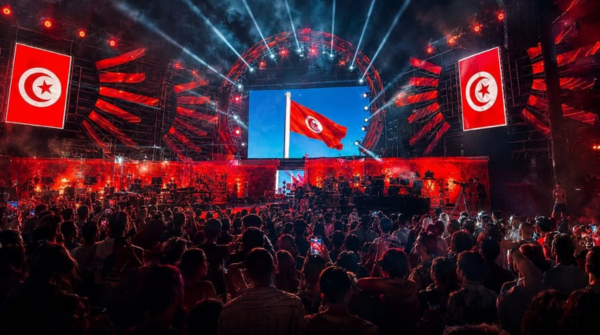
From the memory of Tunisian song to the stars of the Arab world and beyond, the 60th edition of the Carthage International Festival celebrated a rich six-decade legacy while opening its stage to diverse artistic experiences and voices. The festival’s programme came to a close on August 19, 2026.
The 60th edition kicked off on July 16 with “Under the Jasmine”, a performance by Tunisian artist Saber Rebai. The opening night was marked by the significance of celebrating six decades of the festival’s history, revisiting landmark moments in Tunisian music with the participation of several prominent artists, including Lotfi Bouchnak and Bouthaina Ennabli.
Major Arab names soon took the stage at Carthage. Audiences were treated to a performance by Algerian star Cheb Khaled, who returned to the festival after several years away, followed by an international night featuring The Jacksons, bringing the spirit of global pop music to the historic stage.
The programme also showcased a vibrant selection of Tunisian talent, including NordO, Yosra Mahnouch, Nabiha Karaouli, and other emerging and established voices. The Tunisian Symphony Orchestra also took part in a special performance celebrating six decades of Tunisian music. Theatre was represented as well, with “Al-Qarhamana Al-Mokhabbala”, a production by Moez Toumi.
A Diverse Arab and International Line-up
The 60th edition maintained Carthage’s long-standing openness to artistic experiences from beyond the region. The festival welcomed Beninese icon Angélique Kidjo, as well as Sami Yusuf, who made his debut on the Carthage stage. The programme also featured the Italian production Veneziano Rondò, alongside “The Promised Land” from Spain and other internationally oriented performances.
On the Arab scene, this edition brought back several artists whose names are deeply intertwined with the festival’s history, including Syrian singer Mayada El Hennawy, who shared an evening with Mohamed Kheiry, and Egyptian artist Tamer Ashour. Lebanese superstar Elissa also returned to the ancient theatre after a 17-year absence.
Elissa’s concert was among the most highly anticipated events of the festival. Tickets sold out within just a few hours of going on sale, highlighting the enormous anticipation surrounding her return to Carthage.
Carthage Between Memory and Renewal
What defined the 60th edition went beyond the names on its line-up. It also reflected the festival’s attempt to strike a balance between honouring its history and embracing the evolving contemporary arts scene. The programme brought together established Tunisian voices with Arab and international artists, while spanning a wide range of genres and forms, from music and theatre to folklore and orchestral performances.
Through this artistic direction, the ancient theatre of Carthage seemed to reclaim part of its historic role: a space where Tunisian audiences encounter diverse musical traditions and cultures, while also serving as a platform that places Tunisian artists at the heart of one of the country’s most important cultural events.
A Fitting Finale to the 60th Anniversary
After a series of performances spanning more than a month, the festival reached its final stages on August 17 with Amina Fakhet, before officially drawing the curtain on August 19 with a concert by Lebanese artist Majida El Roumi. Her return carried a particular symbolic significance, given the strong connection between Carthage and several defining moments in her artistic career.
From a Tunisian opening with “Under the Jasmine” to a Lebanese finale led by the voice of Majida El Roumi, the 60th edition sought to capture the essence of six decades of a festival that has grown far beyond being a summer event. Carthage has become an integral part of Tunisia’s cultural and artistic memory.
Sixty years have passed. The names, generations and musical styles have changed, yet the Carthage stage has preserved its status as one of the Arab world’s most powerful spaces for creating unforgettable artistic moments and turning them into lasting memories.
