There are things in our lives whose beginnings we do not know, simply because we find them already there before we even know their names. Music is one of them.
In Tunisia, music did not begin on a grand stage, in a recording studio, or with a song topping the radio charts. It began much earlier — in memory, in homes, at weddings, in zawiyas, and in evening gatherings… It began with the human voice trying to transform joy, sorrow, love, and longing into melody.
That is why speaking about the beginnings of music in Tunisia is not so much a search for a precise date as it is an attempt to return to the many layers of Tunisian collective memory.
From Memory to Malouf
When we speak of traditional Tunisian music, it is difficult not to stop at Malouf, a musical heritage that has become one of the most prominent components of Tunisia’s musical landscape.
Tunisian Malouf is closely associated with Andalusian musical traditions that reached the Maghreb through successive waves of migration from Andalusia. Over time, these traditions blended in Tunisia with other influences, gradually giving rise to a distinct Tunisian musical identity, with its own maqamat, rhythms, and nawbat.
But what makes this story particularly fascinating is that Tunisia never treated this heritage as something frozen in time. Malouf lived within society, passed from one generation to another, and gradually evolved from an oral tradition into a heritage that required documentation and preservation.
And this is where one of the most important chapters in Tunisian musical history begins.
The Rachidia… When Tunisia Feared for Its Musical Heritage
At the beginning of the 20th century, there was a growing awareness of the need to protect Tunisia’s musical heritage from disappearing. It was in this context that, in 1934, the Association for the Preservation of Tunisian Music was founded, later becoming known as the Rachidia.
The Rachidia was not simply a musical ensemble.
In one of its fundamental roles, it was a project dedicated to preserving memory: collecting heritage, documenting it, teaching it, and passing it on to new generations. Tunisia’s Ministry of Cultural Affairs identifies among its objectives the preservation, development, documentation, and dissemination of Tunisian musical heritage.
Perhaps this was one of the most significant moments in the history of Tunisian music: the moment when Tunisians realized that a song was not merely a sound that disappeared when a performance ended, but rather a memory that could be lost if it was not preserved.
Then Came Radio… and Everything Changed
If music had previously lived mainly within its local surroundings, the arrival of radio opened another door.
With the establishment of Tunisian Radio in 1938, Tunisian music and song could reach a much wider audience. An artist could move from being a voice known within a neighborhood or a city to becoming a voice heard throughout Tunisia.
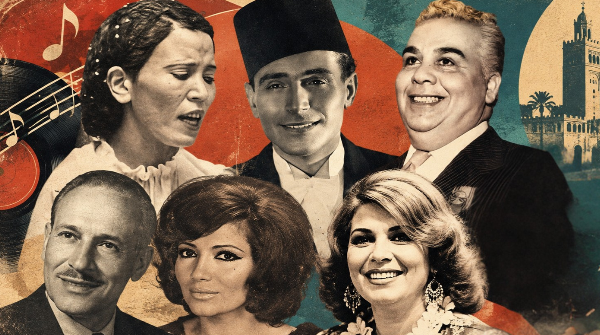
During this period, several names emerged that would become an important part of Tunisia’s musical memory, including Mohamed Triki, Hédi Jouini, Mohamed Jamoussi, Sadok Thraya, and Ali Riahi, alongside voices such as Saliha, Habiba Msika, and Chafia Rochdi, among many others.
The scene was changing.
Music was no longer simply an extension of the old heritage. It was beginning to engage in a dialogue with modernity, drawing on Eastern Arab music as well as certain Western influences, while maintaining a distinctly Tunisian spirit.
From the Nouba to the Song
Perhaps the most beautiful aspect of Tunisian musical history is that it never experienced a complete break between the old and the new.
Malouf, nouba, muwashshah, and qasida did not suddenly disappear when modern song emerged. On the contrary, these forms remained present, while musicians and composers began expanding the boundaries of experimentation and searching for a language that could speak to new audiences.
From here emerged generations that carried the heritage forward, alongside others that reshaped and reinterpreted it.
And this is the secret of Tunisian music: it has never been just one version of itself.
It is Malouf, but it is also the love song.
It is nouba, but it is also music for theatre and radio.
It is heritage, but it is also experimentation and renewal.
The Music That Preserved Tunisia… and Changed With It
When we listen today to an old Tunisian song, we may not always realize that it carries much more than melody and lyrics.
We hear the Tunisia that once was.
The old medina, cafés, weddings, theatres, radio, concerts, and homes where songs were part of everyday life.
That is why the history of Tunisian music is not merely the history of artists. It is the history of an entire society that sang, changed, and preserved its memory through song.
Perhaps this is precisely why the Rachidia has remained present more than nine decades after its establishment, while Malouf continues to be taught, performed, and reintroduced to new generations. Tunisia’s Ministry of Cultural Affairs has documented the existence of a Rachidia archive dating back to 1934, containing recordings and pieces of Malouf and other songs.
And Today… What Remains of That Beginning?
The real question today is not: When did music begin in Tunisia?
It is: What have we done with what was passed down to us?
Because heritage that is no longer heard becomes an archive, and an archive that is never opened becomes a closed memory.
Tunisia possesses a musical heritage that spans many decades, names that shaped its history, and institutions that played a role in preserving that history. But keeping this story alive requires new generations to listen to the old without being afraid of the new.
For music does not live simply because it is old.
Music lives because it always finds someone willing to listen.
Perhaps the most beautiful way to celebrate the beginnings of music in Tunisia is not to place them behind museum glass, but to bring them back to life: in theatres, in schools, on the radio, and through the headphones of a new generation that may discover, for the first time, that the melody they are listening to today began its journey a very long time ago.
This is where the story began… with a voice, then a melody, then a memory.
And Tunisia is still singing today.
